Priscilla Mathew

Scenario-Based ELearning Project
Scenario- based elearning course is made to help the target audience maximize the effectiveness of their customer interaction.
Target audience: Customer service executives in travel industry
Tools used: Articulate Storyline, Adobe Illustrator, MindMeister, Figma
Challenge
Travelfar is a fictitious travel company with a business goal of increasing repeat business and positive reviews company by 50 percent by the end of the year. However, the quarterly sales analysis has poor growth in repeat business and positive reviews. Root cause analysis of the issue highlighted poor Customer Satisfaction Scores after customer-CSR interaction. Customers who didn’t feel satisfied by the customer services often began moving to competing travel companies, leading to a decrease in customer retention and poor ratings.
The Head of Sales contacted me to resolve this performance problem. I used Behaviorally Anchored Rating Scale (BARS) analysis to identify the specific problems in CSR-Customer interactions. It was found out that CSRs lacked empathy and patience in communication when dealing with stressed customers. Some CSRs were also not able to offer resolutions to some common concerns.
Proposed Solution
To bridge the skill and knowledge gaps in the workforce, I proposed a scenario-based eLearning experience, a knowledge assessment and usage of job aids. This eLearning experience would mimic some of the issues that customer service representative has to face in their day to day interactions with the customers giving customer service representatives an opportunity to horn their problem solving skills with empathy and patience.
My Process
Once I determined that a learning solution could help solve this problem, I leveraged my background in softskills training to serve as SME for the project. Creating this process involved multiple stages, constant analysis and iteration.
The first stage was to identify the focus of the eLearning simulation using the action mapping approach by Cathy Moore. Action mapping ensures customer service teams focus on high-impact behaviours and activities to improve customer satisfaction in everyday interactions with the customers. The action map acts as a reminder that the business goal is at the forefront and every action should contribute to achieving that particular business goal. The action mapping I created highlighted the areas the customer service executives need to focus on in order to improve their relationship with the customers.
I used the below action map to break down a complex problem into focused target actions.

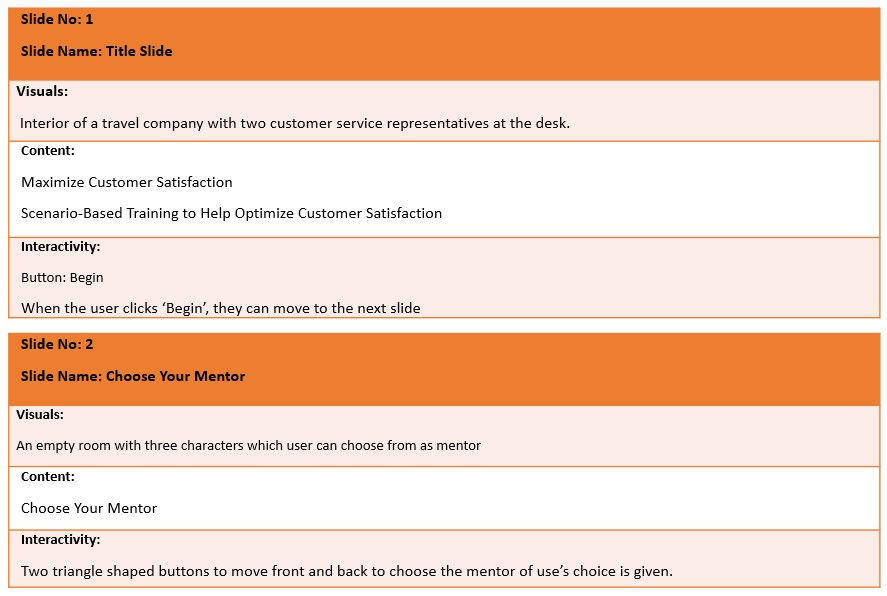
Text-Based Storyboard
After action mapping, I moved into the next stage of development – text-based storyboard. I decided to do scenario-based training. The key action points in action mapping served as correct answer choices, while the common mistakes were used as distractors.
My research helped me to identify real life situations that customer service executives face in their day-to-day interactions with their customers. I got feedback from the Head of Sales Training on the questions and consequences. I had to tweak some of the consequences to mimic the mistakes made by customer service executives in their day to day interactions.


Visual Mock – Ups
Once the text-based storyboard was ready, I moved to the visual design phase. I used Figma to create visual mockups to get better sense of what the project would look like.
I selected a colour theme that aligned with the company’s brand. I then requested feedback on my design choices – layout, colour schemes, fonts, buttons etc. This helped me solidify the look and feel of the project.
As feedback, I was suggested to add more complex animations and interactions to the project. I worked on the suggestions which gave me deeper understanding of variables in Storyline. After multiple revisions, I was able to move into full development of the five-question project.

Full Development
Full development of the project was challenging but rewarding. I get to try out multiple functions of storyline and apply many of them in the eLearning module.
This project helped me gain stronger understanding of instructional design process from beginning to end. I was able to to get hands on practice with tools such as Adobe Illustrator, and Articulate Storyline.
Project Gallery
